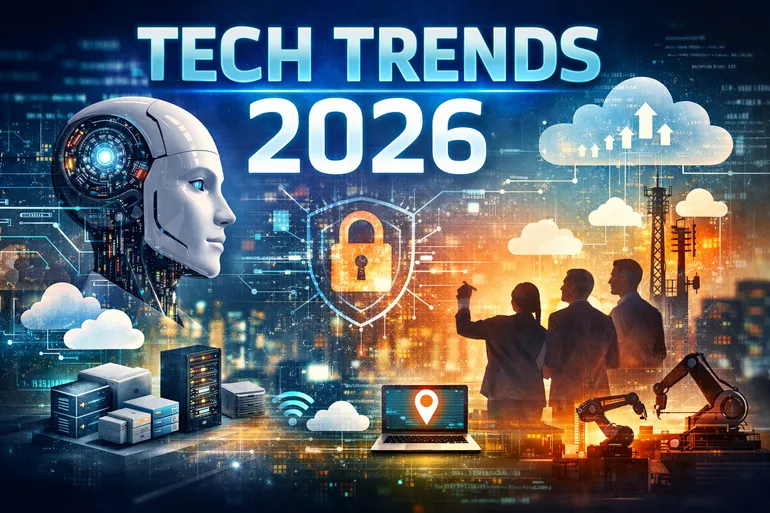
Tech Trends 2026: What Wisconsin Businesses Should Watch
The pace of technology change has always been challenging for small and mid sized businesses, but 2026 stands out as a turning point. Several major technology shifts are moving out of theory and into day to day operations, changing how businesses run, protect data, and serve customers. For Wisconsin businesses, especially those with lean IT teams or no internal IT staff at all, understanding these trends is no longer optional.
What is changing most:
- AI is embedded in everyday tools, not isolated pilots
- cybersecurity risk is rising alongside automation
- cloud and edge systems are more interconnected than before
- staffing constraints make partner support more important
AI Integration Across Business Operations
Artificial intelligence is no longer just an experimental tool reserved for large enterprises or tech companies. Deloitte describes AI moving from experimentation to impact by rebuilding operations and operating models, and Info-Tech highlights multi-agent orchestration as a core trend shaping IT strategy (Deloitte Tech Trends 2026[1], Info-Tech Tech Trends 2026[2]). In practical terms, this means AI is increasingly embedded inside the tools businesses already rely on, rather than being something separate or experimental (Mastercard 2026 Tech Trends[3]).
Analysts describe AI in 2026 as task-specific systems embedded directly into everyday software, handling narrow functions continuously in the background (Mastercard 2026 Tech Trends[3]). For small and mid sized businesses, this shift is significant because it lowers the barrier to entry.
What that looks like in practice is AI features built into accounting, CRM, and help desk tools, automated summaries, routing, and data cleanup, and less need for custom development to see value.
At the same time, organizations that approach AI without structure may struggle. ISACA emphasizes growing pressure around trust, privacy, and governance in cybersecurity planning as AI adoption expands (ISACA: 6 Cybersecurity Trends for 2026[4]). Businesses that establish clear policies around data usage, security, and oversight will be better positioned to adopt AI at scale without introducing new risks.
The Cybersecurity Landscape and AI-Driven Risk
As technology becomes more connected and automated, cybersecurity risks grow alongside it. ISACA notes that AI is now embedded in both offensive and defensive security, and that cloud security is evolving toward continuous authentication and monitoring (ISACA: 6 Cybersecurity Trends for 2026[4]). Info-Tech similarly describes AI as both adversary and ally in the security landscape (Info-Tech Tech Trends 2026[2]). For small businesses, the challenge is not just preventing attacks, but managing complexity with limited resources.
Security planning is also evolving to account for greater automation and more sophisticated attacks. This reinforces the need for layered controls, strong identity monitoring, and ongoing visibility rather than one time fixes (ISACA: 6 Cybersecurity Trends for 2026[4]).
For SMBs, the priorities are clear: stronger identity protection and MFA, monitoring that catches account abuse early, and simple incident response playbooks.
Cloud and Edge Technologies SMBs Should Plan For
Cloud computing continues to evolve beyond simple hosting or file storage. Info-Tech highlights smart sensing networks that combine IoT with edge AI, signaling a shift toward real-time, distributed intelligence closer to where data is created (Info-Tech Tech Trends 2026[2]). For small businesses, this does not necessarily mean managing multiple cloud platforms, but it does mean relying on systems that are more interconnected than ever.
One of the biggest drivers of this shift is the growing demand for low latency and real time processing, especially as AI workloads increase. Edge computing, where data is processed closer to where it is generated, is becoming a practical complement to traditional cloud services as IoT and AI converge (Info-Tech Tech Trends 2026[2]).
These infrastructure changes also place new demands on reliability and connectivity. As more business critical systems depend on cloud and edge services, downtime and performance issues have a greater impact.
Plan for internet redundancy where possible, clear ownership of cloud vendor support, and performance monitoring that covers remote users.
Practical Tech Investments for Wisconsin Businesses
While technology trends often sound abstract, the practical implications for small and mid sized businesses are clear. Start by focusing on a few core areas:
- cybersecurity hygiene that removes common gaps
- AI-enabled tools that save time in daily workflows
- reliable connectivity for cloud-based work
AI powered features are increasingly included in everyday business software, from accounting platforms to customer relationship tools (Mastercard 2026 Tech Trends[3]). Investing in systems that already incorporate these capabilities allows businesses to benefit from automation without adding complexity. At the same time, strong security controls and modern access management are essential to protect those systems.
Another key theme is the role of managed IT and strategic technology partnerships. Smaller organizations often lack the internal expertise needed to evaluate, implement, and maintain emerging technologies. Partnering with a managed IT provider allows businesses to adopt modern tools while reducing risk and operational burden.
The biggest benefits usually include guidance on vendor selection and licensing, rollout planning and end user training, and ongoing monitoring and support.
Preparing Your Team for 2026 Tech Adoption
Technology alone does not create results. Successful adoption depends on people, processes, and realistic expectations. As AI and cloud services become more embedded in daily operations, employees need clear guidance on how tools should be used and where human oversight is still required.
Team readiness basics include short, practical training for new tools, written workflows for approvals and exceptions, and clear escalation paths for issues.
Not every business will move at the same speed, and that is acceptable. What matters is having a plan that aligns technology investments with business goals rather than chasing trends.
For many Wisconsin businesses, preparation means evaluating current systems, identifying gaps, and creating a realistic roadmap. This often includes reviewing security posture, understanding cloud dependencies, and determining where automation can provide the most value.
With the right guidance, these steps can be manageable and cost effective rather than overwhelming.
As 2026 approaches, the most successful businesses will not be those chasing every new technology, but those making informed, strategic choices. AI, cybersecurity, and cloud infrastructure are no longer future concerns. They are shaping how businesses operate today, and the organizations that plan thoughtfully now will be better positioned for what comes next.
References
[1] AI Comes of Age: Deloitte’s 17th Annual Tech Trends Report Reveals How Leading Organizations Are Scaling AI for Outcomes and Impact – Press Release | Deloitte US
[2] Tech Trends 2026 | Info-Tech Research Group
[3] mastercard.com - 2026 Tech Trends.html
[4] Industry News 2026 The 6 Cybersecurity Trends That Will Shape 2026