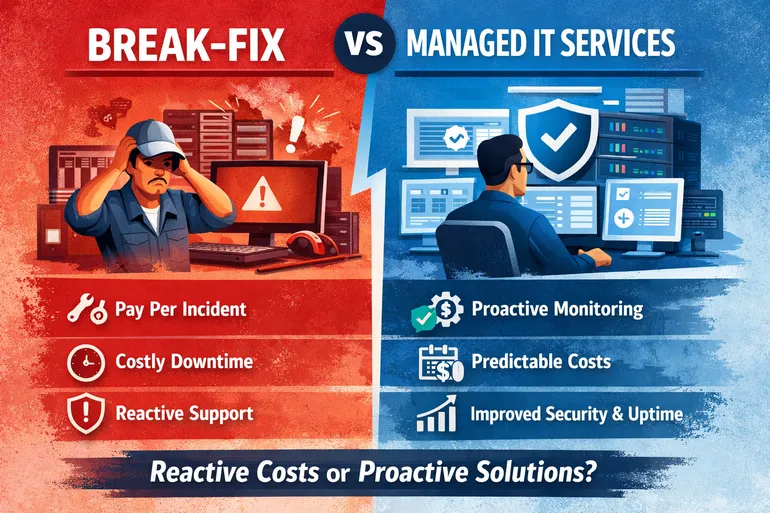
The True Cost of Calling the IT Guy Only When Something Breaks: Break-Fix vs Managed IT Services
Most small businesses start with the same approach to IT. When something breaks, they call an IT guy, pay the bill, and move on. It feels practical, affordable, and flexible, especially when budgets are tight. The challenge is that this reactive approach can hide real costs that only show up over time, often when the business can least afford them.
If you are weighing break-fix vs managed services cost, it helps to look beyond the invoice for the repair. Break-fix IT support can work when systems are simple and downtime feels manageable. As businesses become more dependent on technology, the cracks start to show. Unplanned outages, security gaps, and unpredictable expenses can pile up, quietly draining productivity and profit.
Key takeaways: Break-fix support is reactive and unpredictable, while managed IT services are designed to prevent problems and stabilize costs. The biggest difference is often not the hourly rate, but the downtime, risk, and disruption that come with waiting until something breaks.
What Is Break-Fix IT Support?
Break-fix IT support is exactly what it sounds like. Something breaks, you call for help, and you pay for the fix. There is no ongoing monitoring, no proactive maintenance, and no regular strategy behind how technology supports the business. The relationship is transactional and reactive by design.
This model operates on a pay-only-when-there-is-a-problem basis, which can feel cost-effective in the short term. However, expenses are unpredictable and can spike during critical failures or system outages. Because issues are addressed only after they occur, small problems can grow into larger and more expensive ones.
Break-fix support can also create gaps in accountability. There is little built-in incentive to prevent problems, improve system reliability, or plan for future needs. The goal is to get things running again, not to reduce the odds of the next interruption.
What Are Managed IT Services?
Managed IT services take a fundamentally different approach. Instead of reacting to problems, a managed service provider monitors systems continuously, performs routine maintenance, and addresses issues before they disrupt operations. Services are delivered under a predictable monthly fee, making IT costs easier to budget and plan.
Managed services typically include proactive monitoring, patch management, security updates, and strategic guidance. Rather than waiting for a failure, systems are maintained to reduce the likelihood of downtime and emergency repairs. This shifts IT from a fire-fighting role to a business support function.
For many small and mid-sized businesses, managed services provide access to tools and expertise that may otherwise be hard to justify in-house. The result is fewer surprises, more stability, and technology that supports growth instead of slowing it down.
Cost Comparison: Predictable Fees vs Emergency Expenses
At first glance, break-fix IT often appears cheaper because there is no monthly commitment. The reality is that costs are simply delayed until something goes wrong. When that happens, expenses are immediate, unplanned, and often higher than expected, especially if the issue affects multiple users or core systems.
Research shows that organizations using managed service providers can reduce overall IT costs by 20–30%, while SMBs switching to managed services report IT cost reductions of 25–45% along with operational efficiency improvements of 45–65%. These savings come from fewer emergencies, reduced downtime, and better use of technology investments.
Managed services replace unpredictable invoices with a consistent monthly fee. That predictability allows business owners to plan confidently and avoid the financial shock of emergency repairs. Over time, the cumulative savings can outweigh the perceived cost advantage of break-fix support, particularly for businesses that rely on their systems every day.
The True Price of Downtime for SMBs
Downtime is one of the most underestimated costs of break-fix IT support. When systems fail, employees cannot work, customers cannot be served, and revenue can stall. For small businesses, even a few hours of downtime can have a significant impact, not just on the day it happens, but on schedules and customer expectations afterward.
Over 90% of businesses estimate the cost of an hour of downtime at $300,000 or more, with SMBs often losing $25,000 or more per hour. These losses are not just financial. Downtime can damage customer trust, disrupt operations, and add stress for employees who are already trying to keep things moving.
Reactive IT models can leave gaps in monitoring, which increases the risk of prolonged outages and slower recovery. Managed services reduce these risks through continuous oversight, faster response, and proactive maintenance that helps prevent many outages from happening in the first place.
Most businesses don’t realize how dependent they are on IT until they lose access to it for even an hour. — Matthew Scott, Vice President, Endurance IT (Endurance IT Blog[1])
Security and Strategic Advantages of Managed Services
Security is another cost that often gets overlooked in a break-fix model. When support is purely reactive, security updates and patches may be applied only after a problem is discovered. That can leave systems exposed to known vulnerabilities and increase the risk of a breach or a compliance issue.
Managed services include ongoing security patching, proactive risk management, and support for regulatory requirements. Instead of reacting to threats after the fact, systems are maintained to reduce exposure and improve resilience. This is especially important for industries with compliance obligations, such as healthcare, finance, and professional services.
Managed services can also bring more structure to decision-making. Over time, many managed service relationships evolve into strategic partnerships, where IT becomes aligned with business goals. That alignment supports growth, efficiency, and long-term planning, rather than focusing only on getting through the next emergency.
Choosing the Right IT Support Model for Your Business
The decision between break-fix and managed IT services is not just about cost. It is about risk, reliability, and how critical technology is to daily operations. Businesses with limited IT staff and increasing technology dependence often face higher relative risks from downtime and reactive support models.
Managed services offer a path toward stability, predictability, and long-term value. Break-fix support may still make sense for very small or low-tech environments, but its limitations tend to become more expensive as businesses grow and rely more heavily on their systems. The more your team depends on email, line-of-business applications, cloud services, and secure access, the more costly interruptions can become.
The decision between break-fix vs managed services isn’t just about IT support; it’s about setting the trajectory for your company’s future. — Daren Boozer, CEO, NCC Data (NCC Data Blog[2])
For businesses in Beaver Dam and surrounding communities, the question is not whether technology will fail at some point, but how prepared you are when it does. Moving toward proactive support is often less about spending more and more about reducing the hidden costs that come with waiting until something breaks. If you are evaluating your options, a clear comparison of break-fix vs managed services cost is a practical place to start, especially when you factor in downtime, security exposure, and the stress of constant surprises.